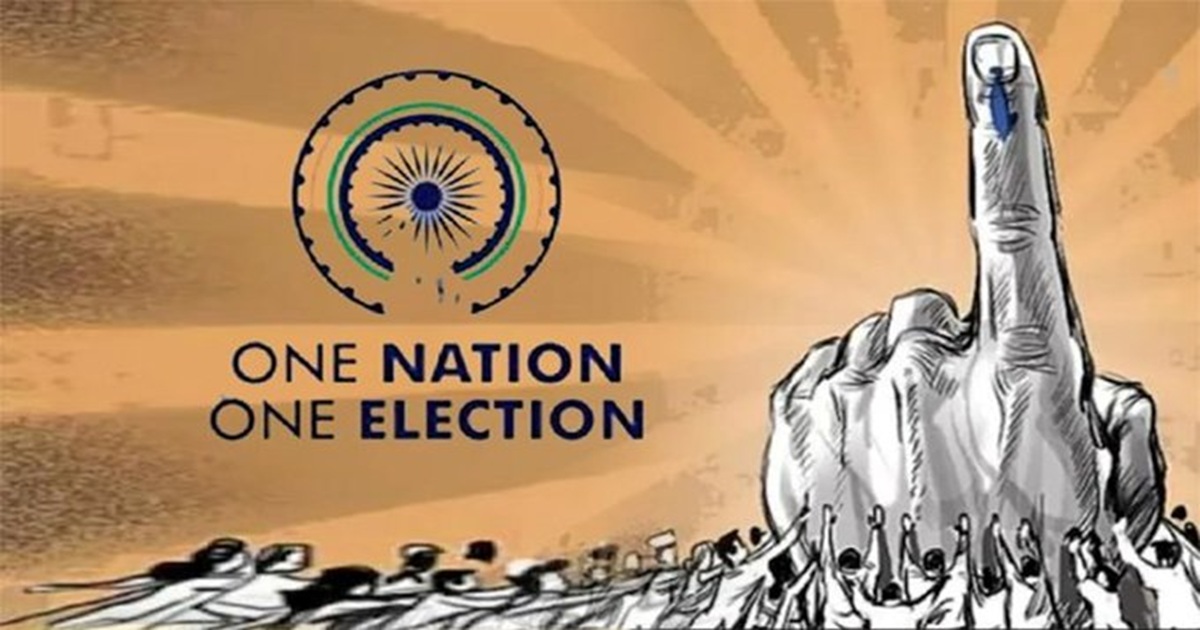
One Nation One Election : The third body problem
The One Nation One Election (ONOE) debate consumes considerable political bandwidth, promising stable majorities and reduced campaign costs by synchronising Lok Sabha and Assembly elections. In the aftermath of an election where the national party outdid the regional parties by a wide margin, the fears of hegemony and advantages for the national parties rose yet again. Yet this entire discussion rests on a myopic premise, that national and state elections are where Indian democracy’s foundations are tested. It so happens that the foundational breakdown happens at a level ONOE proponents and opponents barely acknowledge; local bodies.
Most everyday grievances Indians face stem from local governance failures, not from the timing of parliamentary or assembly polls. Absent waste management, shoddy water supply, non-existent roads, fragile conditions of health centers and schools are municipal and panchayat responsibilities. Yet political attention remains fixed on national-state electoral calendars, while the Constitution already locates everyday accountability in the local bodies.
Since the 73rd and 74th Constitutional Amendments, India has been formally three-tiered. Part IX and IX-A recognise Panchayats and Municipalities as "institutions of self-government," introducing the Eleventh and Twelfth Schedules that clearly list local functions such as water, sanitation, roads, etc. These issues should intuitively be the focus point of elections for the citizen, rather than once in 5 year national-state elections, which are important although their impact on day-to-day life is considerably less perceptible.
The Second-Order Election Trap
The existing election structure, as well as ONOE, treats national and state contests as first-order politics; everything else is secondary or insignificant. When we overshadow local elections under a mega-ONOE cycle, ward-level issues will become even less visible than they are now reduced to mere footnotes in campaigns dominated by national or state narratives.
The problem isn't the election calendar alone. Devolution of eleventh and twelfth schedule functions remains incomplete; state departments often retain effective control. The same argument that states make against the union government’s attack on federal structure, is even more rampant for the state-local body axis. Fiscal autonomy is weak, urban and rural local bodies depend heavily on state transfers and centrally sponsored schemes. These design problems are not addressed and will be compounded by ONOE. Weak state finance commissions, poor adherence to recommendations of multiple commissions affirm the need for important electoral reforms that are needed.
Learning from Elsewhere
International experience shows how institutional design can localise accountability. Post-Suharto Indonesia transferred substantial authority and resources to over 400 districts and municipalities, making local leaders directly answerable for service delivery. Between 2001 and 2020, fiscal transfers to local governments grew dramatically; more than 13% year on year and rose from less than 1 billion US $ to more than 16 billion US $. The paradigm shift was tangible: research found that Indonesian citizens' engagement with local governance grew, rewarding incumbents who expanded service access and voting out those who failed to deliver—demonstrating that decentralised elections can create genuine local accountability when properly designed.
Tellingly, Indonesia itself recently reversed course on a previous attempt at simultaneous elections. After holding national and local elections together in 2019 and 2024, the Constitutional Court struck it down, citing voter confusion and the overwhelming complexity.
Brazil offers another instructive contrast. Since 1989, Porto Alegre's participatory budgeting has allowed neighbourhood assemblies to debate and rank priorities for municipal investment, shifting resources towards poorer areas. Crucially, Brazil differentiates its election calendar: presidential, congressional and state elections occur together, while municipal elections happen nationwide separately. This creates a dedicated window where municipal performance takes centre stage, uneclipsed by state or national campaigns.
Reforms needed
The answer lies with the local body elections. Creating a dedicated electoral moment for local democracy. If local body elections across India are held in a designated time-band, delineated from national and state polls; it would fundamentally shift citizen attention. For that electoral window, citizens, parties and media would have to focus exclusively on local issues. The decentralised nature of elections would give more relevance to localised problems affecting stakeholders which in turn could lead to more tangible outcomes.
Such synchronisation would also elevate local governance in the national consciousness. Currently, local elections happen sporadically, often delayed, receiving minimal to no coverage. A national local-election season would create momentum for civic engagement, bring best practices into public view, and pressure state governments that fail to hold timely polls. This would also revive and reinvigorate state election commissions in order to carry off this exercise.
For this to work, the institutional groundwork assumes a critical role. Devolution of funds, functions and functionaries must be tied more tightly to elected local bodies so that local manifestos align with real authority.
Conclusion
The live question for India isn't whether ONOE can make national and state governments more "stable," but which level of government matters most for citizens' lived democracy. The constitutional amendments of the early 1990s already hint at an answer by enshrining local self-government alongside Union and States.
Indian democracy is currently judged by whether large-ticket missions succeed, whether major projects go through, all related to scale. A shift is needed where it is judged more by how basic functions and services impact citizens through institutions they can engage and influence. Any electoral reform worthy of the name must be built from the ground up, not merely from the parliamentary calendar down. ONOE, in its current form, rearranges dates at the top while leaving the main accountability gap untouched.
A genuine reform would begin with One Nation, One Local Election Season giving India's third tier the electoral visibility and institutional muscle it should have had a long time ago.
About the authors
Harsha Paike is an independent policy researcher
Kiral Singh is Research Associate at FICCI
Popular Categories
Read More Articles

Technology
Dyson’s new Rs 47,000 toothbrush can ‘see’ between your teeth. Would you pay? by Awadh 360° Desk September 3, 2026
Politics
Seven Streams, One Goal: Inside PM Modi's 'Saptadhara' Vision To Build A Viksit Bharat by Abhishek Tandon August 30, 2026
Politics
Bankipur bypoll: More than one seat, Prashant Kishor’s first real political breakthrough by Awadh 360° Desk August 4, 2026
Education
Journey Of An AMU Student Who Became The 'Father Of Indian Molecular Biology' by Afiya Shamshad and Saud Bin Anees August 2, 2026