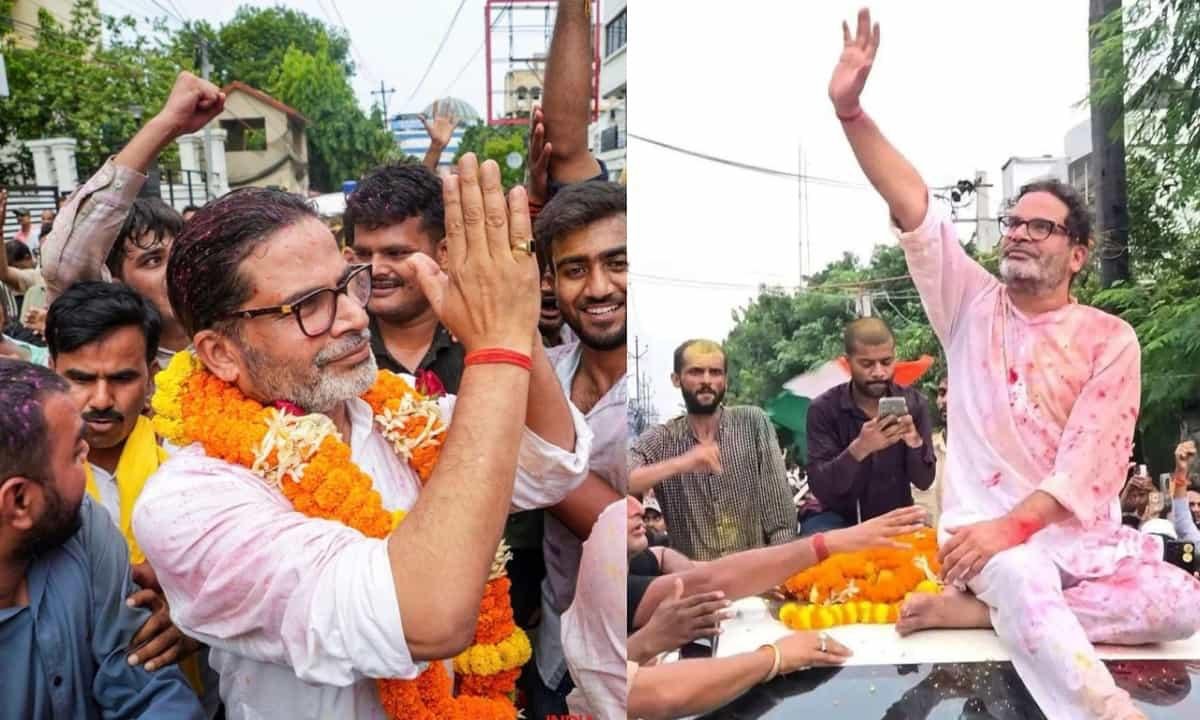
Bankipur bypoll: More than one seat, Prashant Kishor’s first real political breakthrough
The Bankipur Assembly bypoll is not just about a constituency changing hands. For Prashant Kishor, it marks the first tangible electoral success since he entered active politics and launched the Jan Suraaj Party. After suffering successive defeats in the 2024 bypolls and the 2025 Bihar Assembly elections, the victory gives Kishor something he had lacked so far: proof that his political experiment can translate votes into seats.
The result is significant because it is the first electoral victory for both Kishor personally and his party. Until now, Jan Suraaj had attracted attention, secured a modest vote share and dominated political discussions, but it had failed to convert that support into legislative representation.
A break from a series of electoral setbacks
Jan Suraaj’s political journey began with high expectations, but its initial electoral record was disappointing.
In the 2024 bypolls, the party contested four seats but failed to win any. Three of its candidates lost their deposits. The setback was followed by an even tougher outcome in the 2025 Bihar Assembly elections, where Jan Suraaj fielded candidates in 238 constituencies. Despite polling over 1.67 million votes, or 3.47% of the statewide vote share, the party failed to secure a single seat.
Against that backdrop, Bankipur represents far more than an isolated victory. It answers one of the biggest criticisms of Kishor’s political project: that he could generate public attention but not electoral victories.
Breaking a BJP stronghold
The political significance of the result is amplified by where it came. Bankipur has long been regarded as one of the BJP’s safest urban constituencies. Losing the seat after nearly three decades is a setback that goes beyond numbers and raises questions about the party’s organisational grip in urban Bihar.
The BJP had deployed its full campaign machinery. Chief minister Samrat Choudhary, ministers, MPs and senior leaders campaigned extensively for the party candidate. Despite that, the BJP could not retain the seat.
For Kishor, choosing to contest from a BJP bastion instead of a politically safer constituency allowed him to project himself as a challenger willing to take on the state’s dominant political forces directly.
Did the BJP’s candidate switch hurt its prospects?
The BJP initially nominated Abhishek Kumar Sinha Banti, who even filed his nomination papers. However, he withdrew from the contest, forcing the party to replace him with Neeraj Kumar Sinha at the last moment.
While it would be difficult to attribute the defeat solely to the change in candidate, political observers believe the late switch may have created confusion among party workers and sections of the electorate, affecting campaign momentum.
A campaign centred on local governance
Unlike campaigns driven by caste arithmetic alone, Kishor attempted to make urban governance the central issue.
Traffic congestion, sanitation, civic infrastructure, drainage and public services dominated Jan Suraaj’s campaign. In a constituency where voter turnout remained below 35%, the party sought to mobilise dissatisfied urban voters rather than rely solely on traditional political loyalties.
The strategy appears to have worked in an election where motivated supporters played a decisive role.
Youth support appears to have helped
Several election observers believe Kishor performed particularly well among younger voters between 18 and 35 years of age. Issues such as employment, education and competitive examinations featured prominently in his campaign and may have resonated with first-time and younger urban voters.
Although detailed booth-level data will be required to conclusively establish voting patterns, the campaign’s emphasis on youth issues was evident throughout the election.
Months of groundwork paid dividends
One factor distinguishing Jan Suraaj’s campaign was the amount of preparation before the election was announced.
Kishor remained active in Bankipur for months, holding meetings with different social groups and building a grassroots campaign through door-to-door outreach. Once the bypoll schedule was announced, the party intensified an organisational network that had already been established on the ground.
That early mobilisation appears to have given Jan Suraaj an advantage in a low-turnout urban contest.
What does the result mean for Bihar politics?
The Bankipur victory does not alter the balance of power in the Bihar Assembly. However, it changes the political narrative surrounding Prashant Kishor.
For the first time, he can claim that his politics has produced an electoral victory rather than merely influencing public discourse. It also provides Jan Suraaj with legislative representation and greater political legitimacy ahead of future elections.
For the BJP, the defeat serves as a reminder that even long-held urban strongholds cannot be taken for granted. The party has already indicated that it will review the reasons behind the loss.
Isolated Success Or...
Whether Bankipur proves to be an isolated success or the beginning of a larger political shift will depend on Jan Suraaj’s performance in future elections.
Bypolls are often shaped by local issues, candidate selection and turnout patterns, while statewide elections are influenced by broader caste equations, alliances, leadership and organisational strength. Sustaining this momentum across Bihar will be a far greater challenge.
Even so, the symbolism of Bankipur is difficult to ignore. It gives Prashant Kishor his first electoral victory, opens Jan Suraaj’s account in the Assembly and demonstrates that the party can defeat established rivals under favourable political conditions. Whether that becomes the foundation of a larger political movement will be tested in the elections ahead.
Popular Categories
Read More Articles

Technology
Dyson’s new Rs 47,000 toothbrush can ‘see’ between your teeth. Would you pay? by Awadh 360° Desk September 3, 2026
Politics
Seven Streams, One Goal: Inside PM Modi's 'Saptadhara' Vision To Build A Viksit Bharat by Abhishek Tandon August 30, 2026
Education
Journey Of An AMU Student Who Became The 'Father Of Indian Molecular Biology' by Afiya Shamshad and Saud Bin Anees August 2, 2026
India
How Water Infrastructure is Improving Agricultural Productivity, Strengthening Water Security and Enhancing Climate Resilience in Drought-Prone Regions by Kavita Shirvaikar July 25, 2026