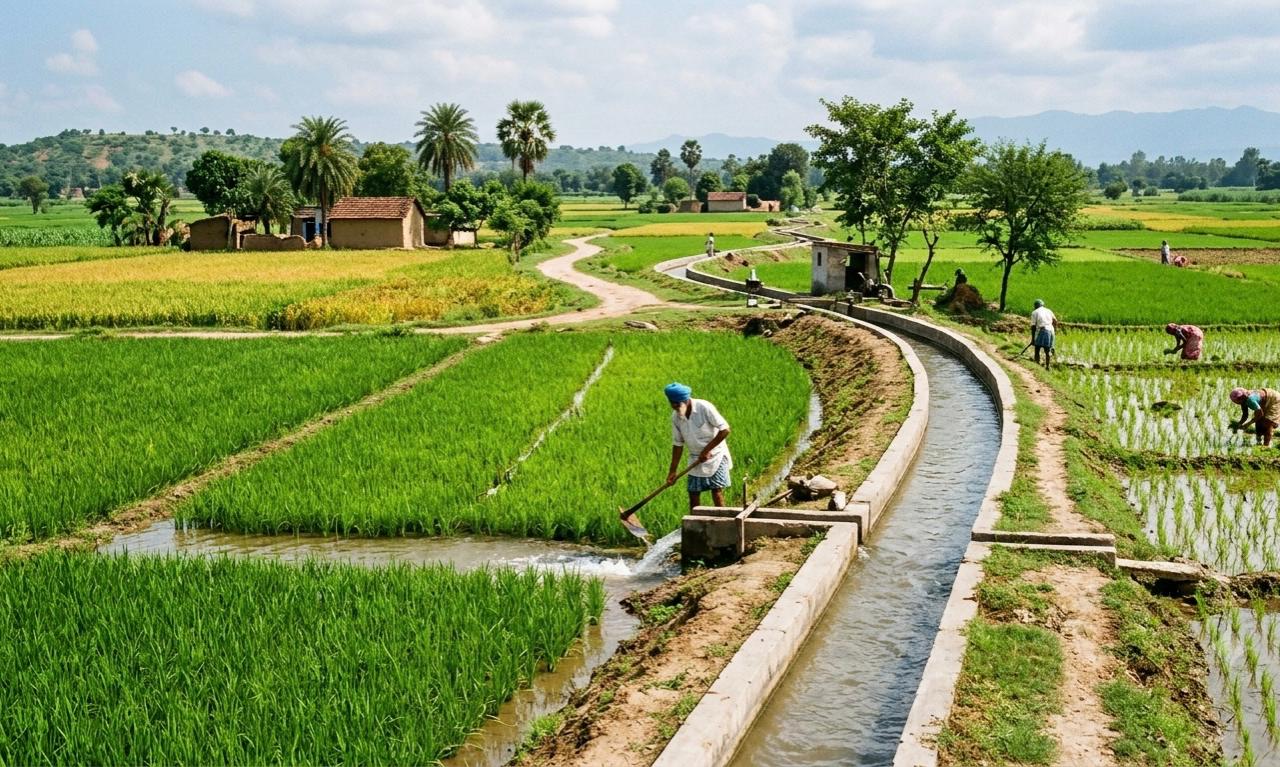
How Water Infrastructure is Improving Agricultural Productivity, Strengthening Water Security and Enhancing Climate Resilience in Drought-Prone Regions
For decades, Indian agriculture has depended on the monsoon. But today, rainfall is becoming far less predictable. Some regions receive intense rainfall over a few days, while others face long dry spells. For farmers, this means greater uncertainty every season.
Agriculture accounts for 80-90% of India's water use, even though India has only four per cent of the world's water resources while supporting 18% of the global population. At the same time, nearly 600 million people already face high to extreme water stress. In this situation, improving water infrastructure is no longer optional. It is essential for sustaining agriculture and rural livelihoods.
Improving Farm Productivity
Reliable irrigation gives farmers certainty that rainfall cannot.This helps them to plan their cropping cycles better, avoid losses during dry spells and grow crops that require a more dependable water supply. This also allows many farmers to move beyond a single seasonal crop and make better use of their land.
States are responding by expanding irrigation infrastructure. Earlier this year, Maharashtra approved funding for 57 irrigation projects and 193 canal works, which are expected to bring 8 lakh hectare under irrigation. The Wainganga–Nalganga river-linking project valued at INR Rs 94,967.66 crore is another important step towards improving irrigation across eight districts of Vidarbha, a region that has faced recurring water shortages.
Large lift irrigation projects are also making a huge difference. Some examples include the Bhima Lift Irrigation Scheme in Maharashtra, that lifts water from the Ujani Dam to irrigate water-scarce areas in Solapur district, while the Jigaon Lift Irrigation Project is expected to improve irrigation in drought-prone parts of Vidarbha.
Similarly, in Telangana, the Kalwakurthy and Jawahar Lift Irrigation Schemes carry Krishna River water to rain-fed regions, while the Bargi Diversion Project in Madhya Pradesh channels water from the Bargi Dam through an extensive canal network to support agriculture.
These projects prove how a well-planned water infrastructure can improve irrigation, support farm productivity and reduce dependence on monsoon.
Strengthening Water Security
Water security is about ensuring there is enough water for farmers specially during drought-like situations.
Dams and reservoirs store rainwater during monsoon, while canals and lift irrigation systems carry it to farms. Watershed development, groundwater recharge and local water conservation measures help replenish water sources and reduce pressure on groundwater.
The biggest change today is that these systems are no longer being planned in isolation. Storage, distribution and conservation are being developed together so that water can be used efficiently. This means better irrigation, more reliable water supplies for villages and greater confidence for farmers duringuncertain weather.
As more irrigation and water management projects come upacross the country, farmers are better placed to deal with changing weather. With access to water when they need it, they can protect their crops, plan their farming activities with greater confidence and reduce the impact of prolonged dry spells.
(Kavita Shirvaikar is Managing Director At Patel Engineering Ltd)
Popular Categories
Read More Articles

Politics
Munich Comes To Delhi: India's Seat At The Global High Table by Abhishek Tandon October 14, 2026
Education
CSR initiatives give Bahraich govt schools an infrastructure boost by Awadh 360° Desk October 5, 2026
Technology
Dyson’s new Rs 47,000 toothbrush can ‘see’ between your teeth. Would you pay? by Awadh 360° Desk September 3, 2026
Politics
Seven Streams, One Goal: Inside PM Modi's 'Saptadhara' Vision To Build A Viksit Bharat by Abhishek Tandon August 30, 2026