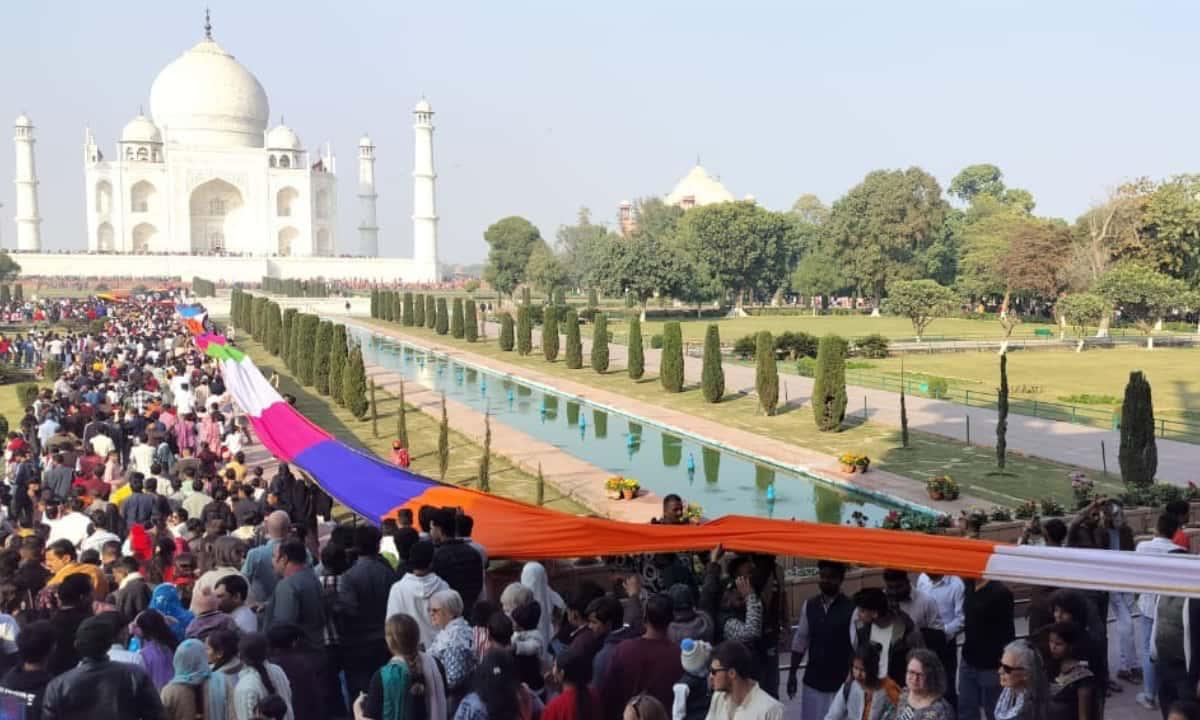
A Symbol of Harmony Draped Over the Taj: Shah Jahan’s 371st Urs Observed in Agra
AGRA: Agra witnessed a rare and visually striking moment on Saturday as a 1,720-metre-long ceremonial chadar was offered at the mausoleum of Mughal emperor Shah Jahan inside the Taj Mahal, marking his 371st Urs-e-Mubarak. The annual observance brought together people from different religious backgrounds, reflecting a tradition that has continued for decades at the world-famous monument.
The Urs, which commemorates the death anniversary of Shah Jahan, was observed with traditional rituals at the Taj Mahal, a UNESCO World Heritage Site and one of India’s most visited monuments. As part of the ceremony, the multicoloured chadar was taken in a procession from the southern gate of the Taj Mahal complex and presented at the emperor’s tomb after the recitation of prayers.
According to organisers, the chadar, made by joining together cloth pieces contributed by devotees over time, measured 1,720 metres this year. The length increases annually as more people add pieces as a mark of reverence. Last year, the chadar measured 1,640 metres, indicating an increase of 80 metres this year.
The offering was made at the original graves of Shah Jahan and his wife Mumtaz Mahal, located in the basement chamber of the Taj Mahal. These actual graves are situated directly below the marble cenotaphs that visitors usually see in the main mausoleum. The basement is opened only on specific occasions, including the Urs, to perform traditional rituals.
Members of the Urs committee said the chadar represents interfaith harmony, with participation from Hindu, Muslim, Sikh and Christian communities. During the ceremony, Fateha was recited and prayers were offered for peace and well-being.
The three-day Urs began on January 15 with the opening of the basement chamber and the performance of the symbolic ritual bath, known as ghusl. Over the following days, events such as qawwali performances, Quran recitation and langar were organised within the Taj Mahal complex. A large number of people attended these events.
In a special arrangement for the Urs, entry to the Taj Mahal for tourists was kept free during the observance. This allowed thousands of domestic and international visitors to witness the rituals and cultural practices associated with the Urs from close quarters. Many tourists were seen observing the procession and ceremonies, adding a unique cultural dimension to their visit.
Shah Jahan, the fifth Mughal emperor, ruled India from 1628 to 1658 and is best known for commissioning the Taj Mahal in memory of his wife Mumtaz Mahal, who died in 1631. Constructed over more than two decades, the Taj Mahal stands as a monument of white marble on the banks of the Yamuna river and is widely regarded as one of the finest examples of Mughal architecture.
Shah Jahan himself died in 1666 and was buried beside Mumtaz Mahal, making the Taj Mahal his final resting place as well. While the monument is globally recognised as a symbol of love, the annual Urs highlights another dimension of its legacy, rooted in cultural traditions and collective participation.
Historical records indicate that Urs observances at Mughal-era tombs have long been part of Indo-Islamic traditions, where death anniversaries of revered figures are marked with prayers, music and community gatherings. Over time, the Urs of Shah Jahan has evolved into a broader cultural event, attracting participation beyond religious boundaries.
Officials from the Archaeological Survey of India were present throughout the Urs to ensure the protection and preservation of the monument. Security arrangements were also put in place by the local police administration to manage the crowds and ensure that the programme proceeded smoothly.
The Urs committee said that the event has been observed for several decades and continues to draw support from people across communities. The practice of extending the chadar each year by adding new cloth pieces has become a defining feature of the observance.
Agra, which relies heavily on heritage tourism, sees a steady influx of visitors during such events. The Urs of Shah Jahan offers travellers an opportunity to witness living traditions at a historic site, providing context beyond the monument’s architectural grandeur.
As the three-day observance concluded, prayers were offered for peace and harmony. With the completion of this year’s Urs, preparations are expected to begin for the next annual observance, continuing a tradition that links history, culture and collective participation at one of India’s most iconic landmarks.
Popular Categories
Read More Articles
Politics
Munich Comes To Delhi: India's Seat At The Global High Table by Abhishek Tandon October 14, 2026
Education
CSR initiatives give Bahraich govt schools an infrastructure boost by Awadh 360° Desk October 5, 2026
Technology
Dyson’s new Rs 47,000 toothbrush can ‘see’ between your teeth. Would you pay? by Awadh 360° Desk September 3, 2026
Politics
Seven Streams, One Goal: Inside PM Modi's 'Saptadhara' Vision To Build A Viksit Bharat by Abhishek Tandon August 30, 2026